Sunday, November 30, 2008

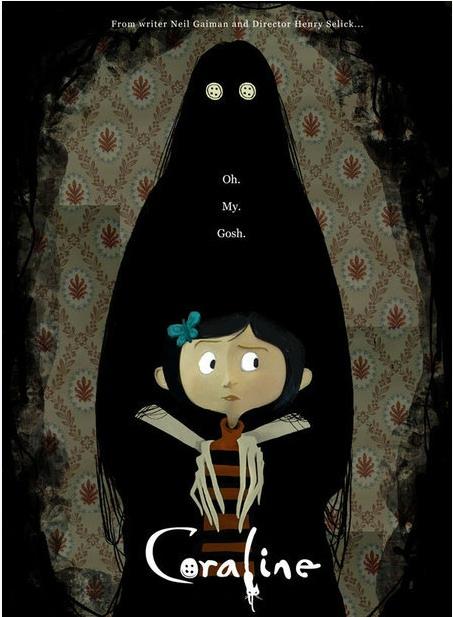
Coraline and Inkheart

I recently read Stardust by Neil Gaiman, who apparently is a fairly famous fellow. I haven't seen the movie of this book--mostly because I have an aversion to book to film projects--but I rather enjoy it. I heard that another one of his books was becoming a film and decided to read that as well. Here's the jacket copy:

"When Coraline steps through a door to find another house strangely similar to her own (only better), things seem marvelous.

But there's another mother there, and another father, and they want her to stay and be their little girl. They want to change her and never let her go.

Coraline will have to fight with all her wits and courage if she is to save herself and return to her ordinary life."

I rather liked this book. The writing is rather frank and plain, but I think that's a part of his style, and the work does not need the extra language. The characters were all lovely and entertaining, and I got a sense that the writer know more than he shared (a very good thing). I'm sort of attracted to that dark, occult-themed work so the mood of the entire work was rather pleasing to me. I'm a tad bit if-y about the end. I'm glad that author was able to tie up all the loose ends, but I'm not quite sure it was needed. Hmph, perhaps if he had not included it, I would have been complaining of the loose ends. : ) A good book, if your kids are not scared too easily, and the movie is directed by the same fellow who did James and the Giant Peach and The Nightmare Before Christmas so the movie is looking pretty good too.

My next book is Inkspell by Cornelia Funke. I enjoyed the first book in the series, Inkheart, except for... the terrible plot structure, so I'm looking forward to this book. Perhaps she fixed the plot, and Inkspell will show what a great writer can do.

Tuesday, November 25, 2008

Through Violet Eyes by Stephen Woodworth (Edit)

I recently went to the public library, and as usual, I picked up several books. Typically, I pick some from the young adult section, a few from the juvenile fiction, and some from the adult fiction bookshelves. One of my adult books was Through Violet Eyes by Stephen Woodworth. It's his debut novel, so I suppose he needs a bit of leeway, but having read the first chapters of book, I cannot say that I'm all that impressed. The characters are incredibly flat and unoriginal. And, the writing is clunky and loaded with 'I'm such a clever writer' character development, which makes the bibliophile in me wince. Trite, I suppose, would be the word to sum it up. I like the idea of the Violets, people who can channel the dead, but I cannot claim to like any of the characters. What a shame sense the cover was so nice. Maybe the characters will get deeper as I get further in the story... I can only hope.

Ha, I actually wasn't lucky enough to find Brisingr in the library, so you all will have to wait for a real rant. Then again, Paolini may have happened upon a less derivative plot and more believable characters, and I will have nothing to report. But, for some reason, I find that unlikely.

UPDATE: Well, I've finished it. Guess what? The entire book was a bad as the first chapters. The characters were all shallow. I've read books where I love certain characters; I've had books where I hate certain characters; but, I've never had a book where I didn't care about any of the characters. 'Til now. On the cover, Iris Johansen is quoted, saying, "A stunning thriller." Funny, I didn't think this was stunning or thrilling, and if I am to go by the credibility of this review, I am in doubt of the use of "A."

The books most rewarding qualities are its ending. It's unexpected and not as clean cut as the rest of the book. The last... 30 or so pages are the fastest paced and best. It's a pity you have to suffer through the first 300 pages to get to them.

Now, onto reading Coraline : )

Sunday, June 29, 2008

The Host


I'm a big fan of the Twilight Series by Stephenie Meyer. Her books are what YA is all about. Originally, I had an intense aversion to this book. I mean, it is a vampire romance, but it's much better than you'd expect. Anyway, I decided to buy her next book, The Host. It is the first of her novels to be printed as an adult novel. In my opinion, it feels very much like her YA novels, and I don't see exactly what is so adult about it. She could have had it published at Little, Brown under the YA category without me seeing the difference. I suppose that she's trying to reach a wider audience.

For those of you who haven't heard, The New York Times has removed children's books from its bestseller's list. They are instead on their own list. I suppose that it because some writers for grown ups got witchy about authors for kids (such as J.K. Rowling). This of course is ridiculous. To separate a single category is like taking out Jazz, Country, or Rock music from winning grammy's because they are not 'serious' music.

But enough ranting. As I've already said, this title is very much like the rest of her works. Her plot isn't driven as much by events as it is by character realizations. Emotions are the main device driving you through the novel, which I don't mind. Meyer does quite well with first person, introspective sorts of work. She's also not afraid to gray things out. While you may initially classify things as black and white at the beginning of the novel, Meyer has tried very hard to slosh the black and white into grayscale.

I will say one thing I was a little disappointed in was the details on the medicine... It seemed much too easy, and any real science buff will be scratching their head wondering what the mechanics of Heal, Seal, and Clean are and why they need specialist for this medicine when a kindergardener could administer it. The lack of detail explanation and the simplicity of it, I think, will turn off true science fiction fans. Science fiction is usually very heavy on explaining things; We want to know not just that it worked but how it worked. Science fiction is different than fantasy. Take the vampires she wrote about in her previous books. I don't care how vampires work biologically that much, because I know that vampires don't exist. They're outside explanation. Science fiction is about what we may be capable of within the usual scientific limitations.

One other note, I think I wouldn't have minded the unhappy ending. Those of you that have read it will know what I'm talking about. I feel like she tacted on the last bit, making a magical solution, where she should have just let it be. She let the character be saved at the last minute, and as an author, I've got to protest against that. Your characters have to solve their own problems, through their own cleverness, but I'll let it slide just this once, because it did make me stop crying at the tragic ending. What can I say? I'm a big softy.

Friday, June 27, 2008

Percy Jackson and The Olympians

I've been reading this series, Percy Jackson and the Olympians, and it's a bit addictive. I can see why it has been on the New York Times best-seller's list. It isn't so much about the turn of phases or the development of the characters that makes these books interesting. It's the action. These books have a back-to-back action scene sort of pace. It feels... very American, very action movie, very much like a book written for boys.

My little brother, who I have to trick into reading, was very interested in these books as soon as I summarized them for him. I'll have to bring them back from my apartment for him to read the next time I venture from my apartment. It's an interesting way to learn about mythology and feel as though you've gone through quite and adventure doing so.

The Lightning Thief, The Sea of Monsters, The Titan's Curse, The Battle of the Labyrinth

Another Writing Sample

This is the eighth chapter of the Wormwood Prophet. Though it is rather short, it is one of my favorites thus far.

The Queen walked on the path beaten by the mourners of the past thirteen days, beaten by her frequent trips to the King's tomb, and she sighed as she went. Her lantern dangled, ringing against the rod she held it by, and she stepped softly. To a watchful eye, the blades of grass bent down before her stride. To a sharp nose, the aroma of incense clung to her. To an attentive ear, the empty hills sang with her presence. Wrapped in a black cloak and having her long dark ringlets fall about her, the girl could hardly be separated against the night.

At age twelve, Amy Wize had never been one for crying, but as she glanced up and saw the tomb laying before her, she faltered.

Black stone walls rose firm and solid above her, and the dark steeple merged with night sky. Stone angels, carved into the walls, played harps, sounded trumpets, and strummed guitars. Had it not been the tomb of her father, Amy might have thought the building was beautiful.

Amy ambled across the stone walk and opened her lantern. The flames she had lit the previous day had died, but smoke still hung in the air. Melted wax covered the surface of the altar, and she made a note to herself to clean it when she visited again in the morning. Amy took a thin stick from her cloak, lit it with the lantern’s fire, and set a new candle aflame.

“May you rest in peace, father.” Closing her eyes, Amy tried to wipe her mind of the last two weeks, but all she could see was her father’s face, without color, devoid of strength, in the hospital. All she could smell was the scent of sanitizers and plastic gloves. All she could feel was the pressure of her hand in his as he passed. He held her so tightly, then his grip left her, and he was gone. Gone forever.

She opened her eyes, wiped them, and sniffed. Written in stone, his name twinkled in the firelight. “I had hoped.” She looked at the name and thought of how permanent it seemed. “I had hoped it would work out this time.” She sighed, kissed her fingertips, and then placed them on her father’s name. “I love you.”

Amy closed her lantern and stepped across the stone walk. She stopped as soon as her feet met the soil. The blades of grass didn’t bend before her. The ground didn’t soften to her step. The crickets, the wind, and the owls didn’t sing to her, and the deep purple sky had turned black.
The Queen’s lantern rose, and her eyes narrowed. Her lips parted, and she trembled with recognition.

The most distant trees vanished against the darkness. Then the closer ones, and then everything became dark as though the scene had all been painted black. Her lantern flickered, and she didn’t move. This was the end, she thought, and the chill surrounded her. The lantern light held onto what looked like the last of its life before suddenly dancing wildly and turning white.
“Brighter,” she heard someone whisper, and the lantern rose.

Something was a approaching. A human-sized something. A boy. In the white lantern light, his blue eyes struck her like lightning. “Help.” His gaze shifted to the lantern. “Brighter.” The light burst from the lanterns frame, and Amy tossed the lantern forward. She closed her eyes as the light illuminated the field, as it grew brighter, as it broke through the darkness.

The grass bent before her. The ground softened for her. The crickets, the owls, and the grass sang to her once more. It was as though nothing had happened, as though the darkness had never come.

The only difference was the burnt plot of land where the lantern had landed and the boy now lying on his back in the grass.

Sunday, June 22, 2008

Beginning to Detest

I'm editing my novel, (I'm about a third of the way through) and it's amazing the tendencies you find in your own writing when you have your words printed before you. A list of words I'm beginning to loathe:

1. Suddenly. This word makes me sound as though I don't know how it came about. Suddenly, he jumped. Doesn't that sound like even he didn't know why he jumped?

2. Seemed. Either something is or isn't. There is no seemed, unless it appears to be one thing but isn't.

3. Nod. If my characters nodded any more, their necks would snap.

4. Repeat phrasing. I detest when I repeat the same description of a single object/setting/whatever in separate chapters.

5. Dangling Participles. Okay, well, I knew of this before writing. I'm aware when I'm doing it. I just ignore the rule of the participle relating to the noun closest to it if it's at the end of a sentence. "He sat in the chair, hoping to not arouse suspicion." In the last sentence, it's pretty obvious that the chair is not afraid of being suspected. "He" is. Still, the arrangement makes me uneasy.

6. Needless words. How'd you get in my manuscript? Cuts her manuscript in half.

African American Literature

I was surfing the net the other day, and I happened upon an article about a woman suing a publisher for classifying her book as African American Literature, which would reduce the readership of the material. If I recall, the publisher was Penguin Books and the author was Millenia Black. Well, I don't really see why any publisher would try to reduce the readership of any book (After all, isn't that how they make their dough?) but this got me thinking of what African American Literature section is.

I've never bought anything from the African American section of any bookstore that I can remember. I may have passed it in a used bookstore or two, but I've never gravitated toward it. Why? Well, I only have a vague understanding of what African American literature means. When I think of this category, I mainly think of romances like "Stella Got Her Groove Back" or "Waiting to Exhale," and I don't read romance unless I'm tricked into doing so. Next thing I think of is the Black history books or books about what it's like to be Black in America. With decades of being excluded from the history books, I do understand a need to "set the record straight," but not being that interested in history in general (I mean, it IS over isn't it?) it's not a section that arouses me. I do like social commentary though. "Things Fall Apart" and "Invisible Man" are excellent books, but honestly, literary novels such as these are almost always depressing. If you look at publisher's websites, you'll see that I'm fairly correct: Random House, Harper Collins.

Well, I thought, maybe I can find something I like in the African American section. I happen to like fantasy (haven't I already eliminated all the other categories?) Apparently, my people don't like fantasy. I went to blackexpressions.com, and they specialize in African American Literature. Get this, they don't have a fantasy section. Neither does blackbooksdirect.com. Strangely, I did find an 'urban fiction' section. I'm not quite sure what that means.

So I suppose, I now get the gist of this section, but why the separation? Aren't romances with black characters romance? I know, when I do read romance, I often replace the race of characters (Why can't Stephane be a dark-skinned Indian man if I want him to be?) Isn't Black history history? Aren't Black literary works literary works? And, what makes the work Black or African American? Is it the author? If the author wrote about all White, Middle Eastern, or Asian characters but were Black, would their works still be in the African American section? If a person of a different race wrote story with all Black characters, would their work be in the African American section? It's puzzling.

Tuesday, June 17, 2008

Diary of A Wimpy Kid

I've just finished reading Diary of A Wimpy Kid: Roderick Rules; Prior to this, I read Diary of A Wimpy Kid. RR has been on NY Times' Bestseller list for 21 weeks, and the original book has been on for 60 weeks (Yeah, that's more than a year.)

If you have kids (I have younger siblings) who do not like to read, you may be able to push these books on them without too much fuss. Half of the book is drawings, and the drawings work well with the writing. You have to read and look at the drawings to get the jokes, and I've found these books to be terribly satisfying. The point of view is realistic. The voice is strong; It sounds like a real kid (granted a selfish, self-centered kid) is talking to me. An excellent read that will have you laughing as you read.

Watch out for the cheese touch.

Monday, June 16, 2008

More Reasons for Not Reading

1. The first paragraphs of your novel describe your main character preparing for their day. This is especially bad if these rituals tell us nothing about the character--that they hate how they look, that that don't care how they look, that they are irresponsible, whatever.

2. In your story's synopsis, you describe your work as being in between the style of fabulously famous authors: Stephen King, Dean Koontz, J. K. Rowling, Pullman, C. S. Lewis, Stephenie Meyer, Dan Brown (you can take it from here.)

3. You think you are writing something no one else has ever written before. Poor thing.

4. You've posted 25 different stories to your Fiction Press account, and all of them have only one chapter. Even if I like your work, I won't read it, because you probably won't get too far with it.

5. Your characters' names mean things. For instance, you have a character named Ivy who controls plants, and you have character named Felicia who has a thing for cats. (Thank you comic books.)

6. Your characters' names consist of alliteration such as Mickey the Mouse. Come on. Even your kids are getting sick of that.

7. You think you're too good for grammar.

8. You have a narrator that pops in and tells us annoy things like, "Little did Jimmy know he'd regret that decision." "You and I know Johnny shouldn't have done that, because we all know that moths and butterflies are the same thing."

9. You just used 'enthused.' *shiver* I love you Stephenie Meyer, but you did this (well, you used unenthused) in your last book, The Host. I know it's become popular to use this "word," but it just feels so wrong. I believe you also used the word aggravate in place of irritate in your Twilight series.

10. You don't know the difference between an adjective and an adverb.

Wednesday, June 11, 2008

Why I Won't Read Your Writing

I've been scanning some entries on fiction press and critique circle. The majority of the writing is terrible. The funny thing is this one person kept complaining about not getting comments on their work. To this person, there is a reason for this. People don't comment on stories they haven't read (usually). Here are some reasons why I read the first paragraph of your story, hit the back button, and look for another story to check out.

1. You do not know how to use commas. Commas are the most used punctuation in the English language (perhaps behind the period, but most folks know how to use those).

2. Your sentences aren't sentences. I use incomplete sentences all the time, but I use them sparingly and on purpose.

3. Your story is in present tense, and you obviously don't know how to use it. Jeez Louis. There's a reason why so many stories are written in past tense. Not being able to use it correctly just confuses the reader.

4. You don't know where to put the commas, periods, or quotations when someone is speaking. You think someone can cough, "I love you." This just makes you look stupid. Nearly all fiction has dialogue in it. A good ninety-nine point nine percent of it has to. Not using quotations correctly shows you have not read enough to know how to use them correctly; thus, you have hardly read anything at all.

5. Your sentence length averages more that fifteen words. If I'm fighting to read every sentence, I'm not going to get to the end of your story.

6. You don't know what 'show don't tell' means in a literary sense.

7. You don't know where the spell check is on your computer, and I can tell.

8. You own a thesaurus, and I can tell.

9. You just spent ten sentences describing a doorknob.

10. Every other sentence, you break up the flow of the story to tell us how your character feels or what they are thinking.

11. I've gone through the first two paragraphs of your story, and nothing has happened.

12. Your characters are always talking, but I never know where or when or what anything looks like. This is also known as you are too lazy to describe the location, setting, et cetera.

13. You have used ten words where you could have used one word.

14. Your main character's name looks like this: Kkfoieownownf.

15. Your story (God forbid) is written in second person.

Tuesday, June 10, 2008

Chapter 1

Dying wasn't hard. There was a flash of light as the truck collided, a surge of pain, and then nothing. I don't remember hitting the ground, or maybe that was wrapped in with the rest of the pain. My last thought was that I was awfully glad I had clean underwear on.
------

My name is not Frankenstein, however once you get ran over by truck, threaded back together, strapped to a table, and struck by lighting, people get it into their heads that they can rename you.

Twelve years being called one name, and someone can just start calling you something else. It's true. A name for coming back to life seems like a fair trade, but Frankenstein? That's what the reporters decided to call me. You'd think that journalist, who write for a living, who string words together like fabric, who search for the truth in everything, could be a bit more clever.

Everytime I hear my new name in the papers, on television, on some radio show, I still don’t think it’s me. I don’t think, that’s my name. All I can think of is that dude with bolts sticking out of his head moaning and walking like he can't bend his knees, and I hate it.

In case you're wondering, I don't have bolts in my head or walk like that, and I don't moan either. I stutter sometimes, but no one ever notices. I don’t talk. The reporters never ask me questions, and when they do, the doctor always interrupts like he has a better answer.

I hate the doctor.

“Frankie,” he said when I first met him. He stood next some electrodes, which I was certain were there just to look impressive. “I've accomplished what no other man has.”

I was just waking up then. My vision was blurry, but I could make out the cold mechanical look of the laboratory and the calculating tone of the doctor's voice. I didn't like it. “Excuse me?”

“I've brought you back to life, Frankie!” He had his hair growing in all sorts of directions, and it looked like he'd gotten the electric shock, not me. Maybe he was trying to look like Einstein. Maybe all mad scientist looked like that. Maybe it was a law. “I'm a genius,” he said and smiled widely.

I looked around me. No one else was there but us. Who was this Frankie he was talking to? I wasn’t a shrink, but it seemed obvious to me that this man was crazy. He had brought me to some lab, was talking to a Frankie, whom was not there, and was claiming he'd brought someone back to life. “Ah, that's very n-nice, sir.” I searched for an exit. “I think I'll go now.”

I tried to slide off the operation table, and then I noticed the stitches on my legs and arms. My clothes had been changed too. I was in a hospital gown. My eyes popped. “W-What have you done to me?”

“I've already told you, Frankie.” He looked dead at me. “I've brought you back to life.” He curled his lips, and I didn't curl mine.

I suppose I should explain the death part. That’s what everyone wants to know. The way the doctor explains it, I was an angel cut down in his prime. He says that I never said a bad word, that I always went to Sunday School, and that I jumped infront of the truck to save a cat. I don’t remember it that way.

To tell the truth, I was skipping school. Now, I’m pretty smart and everything. I don’t have anything against school or English, but English teachers are another thing entirely.
Miss Bernan has always hated me. Whenever she assigns seats, she always makes me sit in the first row, and she always calls on me to answer the hard questions. Even when we turn in our papers, she always spends at least five minutes more on mine, just to make sure she’s underlined and circled everything in red.

It’s all because one day, when she was the subbing for my fourth grade class, I corrected her when she wrote ‘farther’ instead of ‘further’ on the board. It’s no big deal, you know. People mess that sort of stuff up all the time, but she told me I was wrong. I had to spend five whole minutes explaining the difference to her. One thing about adults, they don’t like to be corrected. They don’t like looking stupid. Well, Miss Bernan really really didn’t like to look stupid, and she has hated me ever since.

So when I heard Miss Bernan was going to give us a pop quiz as I walked to school, I just kept going. I walked past the gas station, past the post office, past the video store, to the neighborhoods where kids played. There were a few rows of streets that broke off from the main street and didn’t go anywhere. On these streets, there weren’t too many cars to break up street baseball or stop kids from playing right in the middle of the road, and when a car did roll through, they always drove slowly with the driver looking all over for kids.

It was different during the middle of the school day. First off, there weren’t any kids, and there were hardly any cars in the driveways. It all felt too quiet, too dead to be real—like one of the sets they build for tv movies.

I guess, that’s why the truck was going so fast. It didn’t expect to see a kid in the middle of a school day, and I didn’t expect anything to be racing down the middle of the street toward me.

As far as the cat I was supposedly saving, I don’t remember seeing it. All I saw was a blue old-fashioned truck heading toward me, and as I far as never saying a bad word in my life, the doctor must not have been listening just before the truck hit.